
Small Group Basics
Getting Started
Contact the members of your small group within the first few days of the start of the term. You can find your group in Canvas by going to the “People” link on the left side of your course. Then click on the "Small Groups" tab.
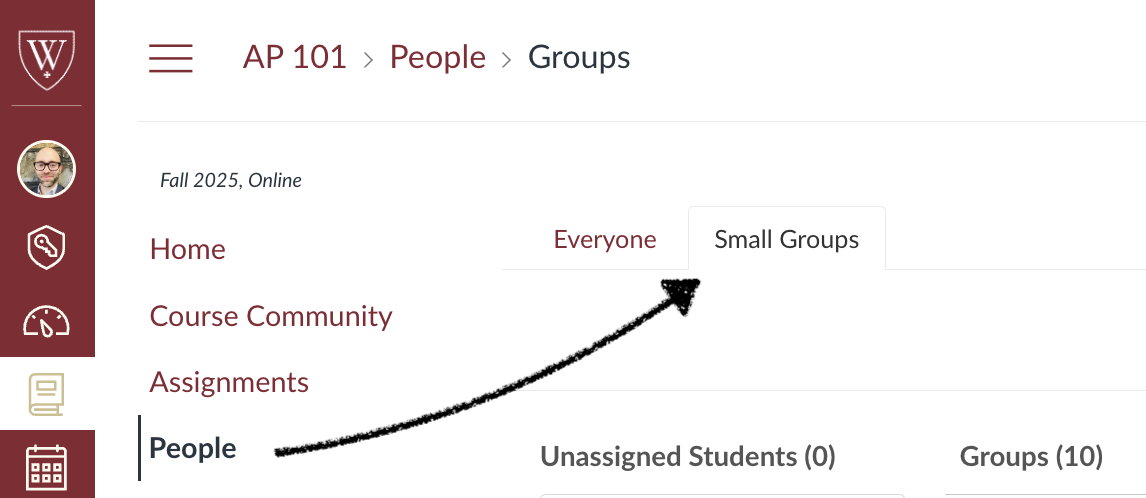
Tip: You can also click on “Groups” from the main navigation menu to see your small groups listed for all courses.
Once you know the names of your group members, you're ready to find them in Circle. By the way, some students use a nickname in Circle, so you may need to search by last name.
Connect initially by creating a group chat in Circle. Communicating this way helps consolidate all your communications into one place. Your goal at this point is simply to establish the date and time of your first meeting. You can then take the first 15-20 minutes of your first meeting to get to know one another and schedule the rest of your meetings.
When it's time to meet, go to the Zoom links for Small Groups page (located in the top Course Information module in Canvas). Then click on the link that has been designated for your particular Small Group.
Small Group Meeting Norms
- Before you meet, plan to reflect on the week's discussion prompt(s). Preparation is crucial for a fruitful conversation.
- Each meeting should typically last one hour.
- To receive credit, mark your own attendance in the week's attendance quiz.
- For most courses, you will be required to provide a brief summary of takeaways from the meeting.
If you had a question that you could not answer in your small group meeting, we encourage you to submit one through the attendance quiz. Instructors will typically respond via Circle.
Alternative Assignment
If you are unable to attend a small group meeting, please contact your small group and let them know. You may then submit an alternative assignment to make up for the missed meeting. Since we prioritize conversation with peers, the most you can earn for the alternative assignment is 85%. This option can only be utilized twice during any term per course.
If you are experiencing an emergent and unavoidable scheduling conflict, please reach out to your instructor. They may decide to grant an exception and allow up to 100% credit for the alternative assignment.
The alternative assignment can be submitted within the small group attendance quiz. Please draft your response in a document and save it to your computer, and then copy and paste your answer into the space provided. You will be required to answer the discussion prompt(s) in 400-500 words.
Frequently Asked Questions
-
How do I contact my small group members?
We recommend direct messaging in Circle to contact your small group members. You can simply open “Direct messages” from the dialog icon 💬. Then click on the '+' New message button. Then you can enter your small group member’s names and send a message to your group.
-
What if a group member is not responding or drops the course?
If someone in your group is not responding, please reach out to support@wts.edu. We may be able to help you connect. In some cases, you may have to move forward with the small group meeting without the non-responsive member.
If you are in a group with at least three members after a small group member drops, then you can continue to meet without a new member. If you are in a group of two, then you may either choose to continue to meet together or reach out to support@wts.edu to ask for a reassignment. If all members of your small group drop the course, then please reach out to support@wts.edu to be assigned another small group.
-
How are groups determined?
Our goal is to place you within the same timezone as others in your group. However, if you are in a time zone that differs from others, we will try to place you in a smaller group (for reduced scheduling constraints). We aim for groups of three to five members.
-
What if I have to miss a number of meetings during a term?
If you are unable to attend any of the assigned small group meetings, then you can submit an alternate assignment for 85% credit. If extenuating circumstances require you to miss a number of meetings and you are aware of this at the start of the term, then please reach out to support@wts.edu to see if any other arrangements can be made.
Also, please notify your small group members so they can proceed without you.
-
What if I want to be in a different group?
We do not allow you to change groups once the term has started unless you have a personal conflict (which will be reviewed by Student Success). Please reach out to support@wts.edu if you find yourself in a difficult situation or if you feel a group member is in violation of our community values.
-
Can I stay with the same members in my current small group in future courses?
Due to the varying number of students and their locations, we cannot commit to keeping the same small groups together.
Some students have created their own small groups outside of courses as well. You could stay in touch by creating a chat room in Circle.
-
How do we meet? Where do I find the Zoom link?
You can find Zoom links for your small group meeting on a page entitled "Zoom Links for Small Group Meetings" in the first module of your course in Canvas. Please make sure to use the correct Zoom link provided in the table.
-
What if our Zoom link is not working?
If the Zoom link for your small group is not working, please contact support@wts.edu.
-
Why do we require small groups at all?
Small groups are an important part of how we design theological formation in the online learning context. Discussion with one another—as well as with your instructor—is critical for growth in three main ways. First, small groups provide a low-stakes setting for retrieving, synthesizing, and using what you've learned. Second, you and your group members will inevitably observe and approach things differently—whether you're looking together at a difficult passage of Scripture, a doctrinal formulation, or attepting to apply what you're learning in context. If approached out of patience and love, this can not only be a site to speak your mind, but also gain new insights and develop habits of emphathetic listening and learning from others. Finally, small groups provide a setting for meeting fellow brothers and sisters to pray and encourage one another. In several cases, this has lead to meaningful friendships and even ministry partnerships.